Protecting a pressure regulator with a coalescing filter
If you sell or specify pressure regulators, you already know they fail from dirt. What often gets missed is liquid.
Oil mist, condensate and fine aerosols travel with the gas. They wet the seat, stick the valve, and ruin regulation long before the small inlet disc looks blocked. A coalescing filter fitted upstream of the regulator is the standard way to stop that.
The inlet disc is not enough
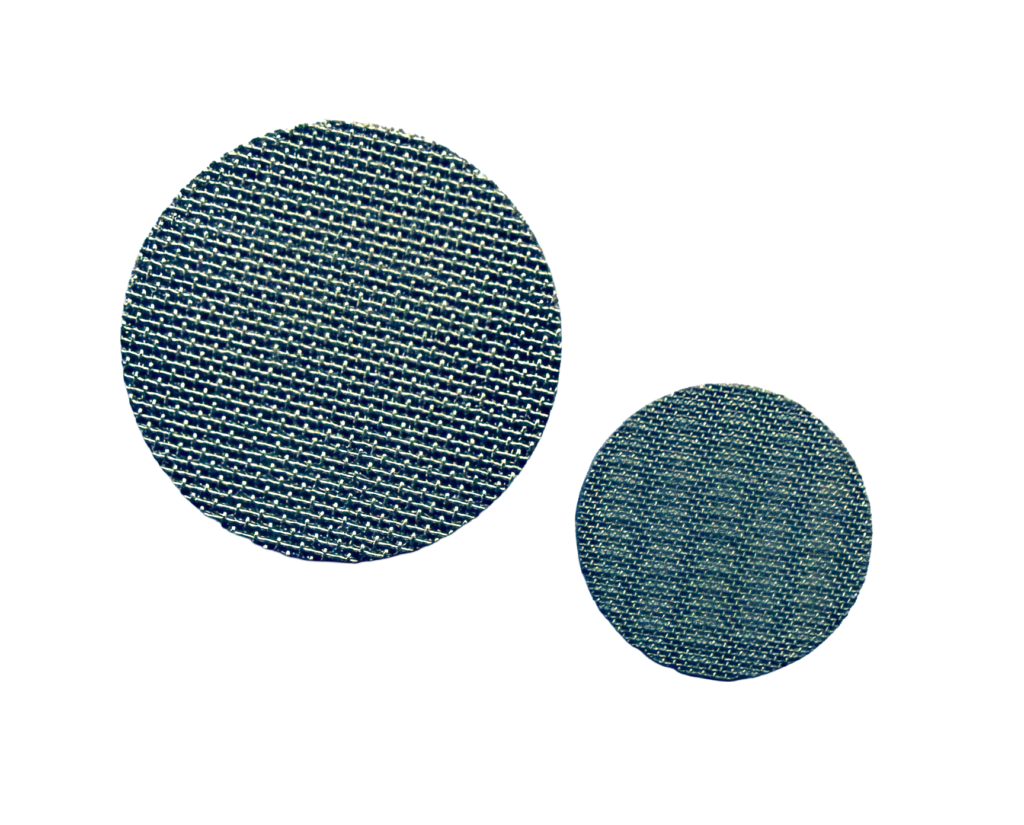
Most pressure regulators have a small flat filter disc in the inlet port, usually 20 or 40 micron. We cover that on our pressure regulator filters page. The disc has very little surface area, so solids block it quickly. To change it you have to break the compression fitting on the inlet.
It also does almost nothing with liquid aerosols. Those pass through a coarse disc and collect on the seat and the spring. Service life drops, outlet pressure wanders, and the regulator comes off the line.
A proper filter housing in front of the regulator gives you a much larger element surface area. You change a filter element, not service the regulator. If you take the inlet disc out to raise flow, that upstream housing is essential.
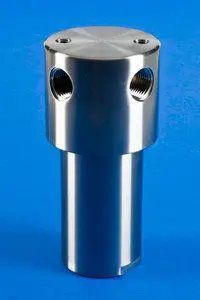
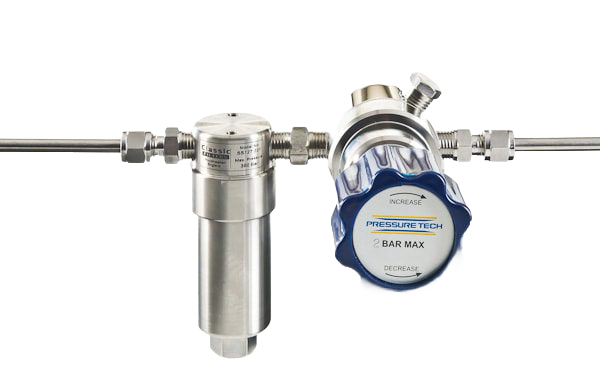
The assembly below is one of ours: a SS127.221 filter housing (316L, 350 bar) piped straight into a pressure regulator.
Why coalescing, not only particulate?
A particulate element catches solids. A coalescing element does that and also knocks the liquid out of the gas.
Our coalescing elements use bonded borosilicate glass microfibre in two layers. Gas flows from the inside to the outside. The inner layer is the high-efficiency stage. Fine aerosols collect on the fibres, join together, and grow. The coarser outer layer lets the liquid drain down into the bowl.
Efficiency is up to 99.99% of 0.1 micron aerosols and droplets. The same element also removes particles, so one housing covers both jobs on a regulator inlet.
Keep the housing the right way up
Coalescing only works if the element stays vertical and the liquid can drain. A traditional T-shaped housing does this, but the drain is on the bowl. To change the element you have to break the drain tube first.
Our SV inverted coalescing housings put the inlet, outlet and drain in the head. The element stays vertical. You service the bowl without disturbing the drain fittings. SV117, SV127, SV215 and SV235 are available from stock.
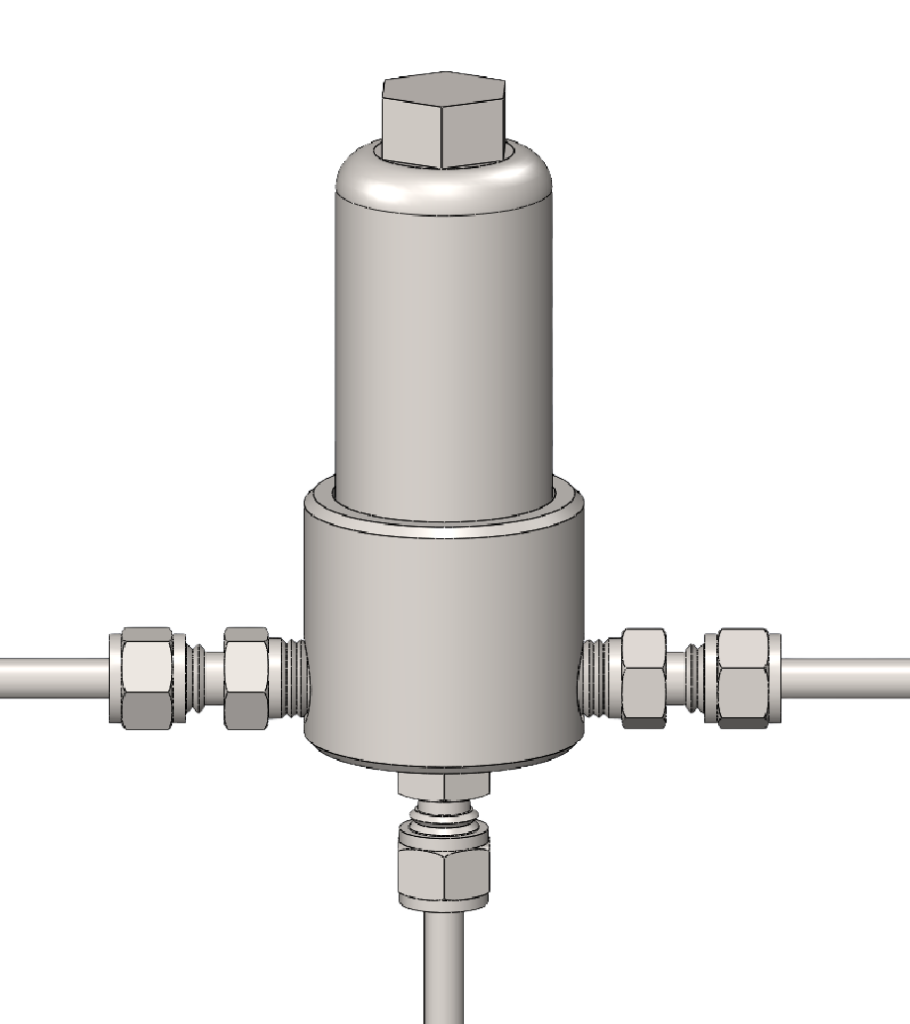
For 1/8″ and 1/4″ lines the SV117 and SV127 are the usual starting point (316L stainless steel, up to 350 bar, NPT as standard, BSPT and BSPP on request, NACE MR-01-75, PED). Larger line sizes can use the SV215 and SV235 series.
If the regulator is pilot-operated, look at the SS147 series. It is built for that duty: a high-efficiency coalescing element on the pilot supply so the control valve stays clean.
Drain the liquid, or it goes back in
A coalescing housing without a working drain is just a wet pot. Liquid has to leave the bowl.
On a small instrument line a manual drain is often enough if someone is there. On a continuous gas supply fit an automatic drain (our DN103 and DF105 stainless steel drains connect straight to the housing drain port). If slugs of liquid are large, add a drain vessel so the bowl does not fill between visits.
Change the microfibre element before the pressure drop reaches 0.7 bar. Disposable microfibre elements cannot be cleaned. Solids sit in the depth of the media, not on the surface. Our elements are industry-standard sizes, so they also fit many housings you may already have on the plant.
What to tell us when you specify
We need the same facts you already collect for the regulator:
- Gas or liquid, and what is in it
- Maximum pressure and temperature
- Line size and port type (NPT, BSPT, BSPP)
- Flow rate
- Whether you need to remove aerosols, particles, or both
- How often you can service it
Use the applications form or call us on +44 (0)1634 724224. If you would rather work locally, your Classic Filters distributor can size the housing with the regulator they already sell.
Talk to us
If you are a regulator manufacturer, an instrumentation distributor, or an end user with wet gas on the inlet, we can help you pick the housing and the element grade. Email [email protected].